

Most advertising advice you read online is written for B2C. The author assumes you’re selling things like sneakers, skincare, or snacks to everyday people. A lot of it is really good advice… if you’re advertising things like sneakers, skincare, or snacks to everyday people. These “best practices” doesn’t say “this is for B2C,” but they either assume so or the author doesn’t know any better and thinks what works for them works for everyone.
B2B is a different game. You’re selling to other businesses. Your buyer isn’t one person — it’s a group. The sale doesn’t close in seconds — it can take months. The price tag isn’t $40 — it might be $40,000 or more. And your pool of buyers isn’t millions of people — it might be a few thousand companies, tops.
So when you blindly take cues from B2C advertising experts, you can quietly burn through your budget without knowing why.
I use the word blindly with purpose. Most of the tips below aren’t wrong. They just need to be adjusted before you use them or used selectively inside a larger advertising strategy. Let’s walk through eight of the most common ones.
1. “Forget targeting. Go broad and let the algorithm sort it out.”
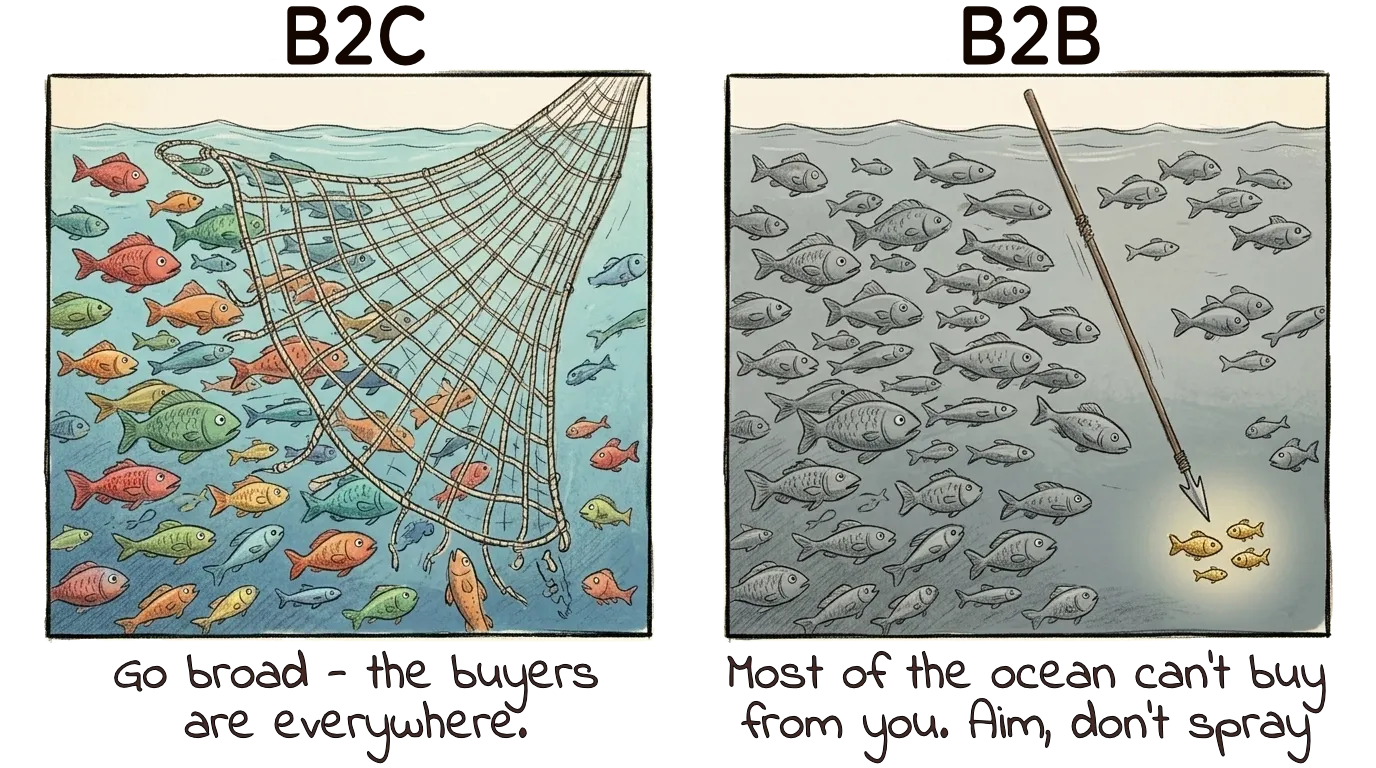
Where this comes from: On platforms like Meta, the advice now is to stop hand-picking interests and just let the AI find your buyers. With a huge consumer audience, the system can test your ad on lots of people and learn who responds. For B2C, this often works great.
Why it can hurt B2B: Your real audience is tiny. Maybe only a few thousand companies on the planet can actually buy what you sell, and among those only a small percentage open to changing vendors or in market. “Going broad” on a consumer platform means showing your ad to a flood of people who will never be your customer — students, retirees, anyone scrolling. The algorithm doesn’t naturally know what a “VP of Procurement at a mid-size logistics company” looks like the way it knows “person who likes hiking.”
It’s worth mentioning that this problem is compounded by a lack of signal because conversions in B2B are few and far between. But I’m getting ahead of myself - more on that in number 5.
What to do instead:
- For most ads, keep your targeting tight enough to stay inside your real buyer universe (by industry, company size, and job role). Focus on a specific list of people and companies that match your ideal customer or who have interacted with your website or sales team.
- The Exception: If you are marketing a lead magnet that is applicable to anyone in market for your product or service or not in market for your product or service with the goal of building a list, often times going a broader works well - just make sure your offer is only relevant to the right people and companies you want on your list and you give the ad platforms a good starting point to build lookalikes from.
How Path3 Helps
- Path3 has built in a concept of open audiences and closed audiences. Open audiences let you leverage algorithms to go broader, outside the accounts and people you know you want to target. Closed audiences stick to the folks you know are right to buy from you.
2. “Throw all your ads into the pot and let the algorithm pick what’s best for whom.”
Where this comes from: In B2C, the same algorithm that knows who to target can also know what the best performing creative is based on how people respond after having seen, watched, or interacted with it.
Why it can hurt B2B: It’s not nearly as easy to connect the dots between who saw an ad and who bought when it comes to a B2B sale. Because B2B deals are big and involve a group of 6 to 10 people, one person may be influcence by an ad, then advocate for the sale with another person who actually converts. So even uploading closed sales might miss the connection and the ad platform has no new information to know which ads work for what.
What to do instead:
- Optimize each piece of creative based on its goal and medium.
- Make sure all creative is seen by as many people who can influence the sale as possible.
How Path3 Helps
- By organizing ads by audience and objectives, you can compare which creative and content performs better than others for that specific goal.
3. “70% of your advertising budget should be platform spend.”
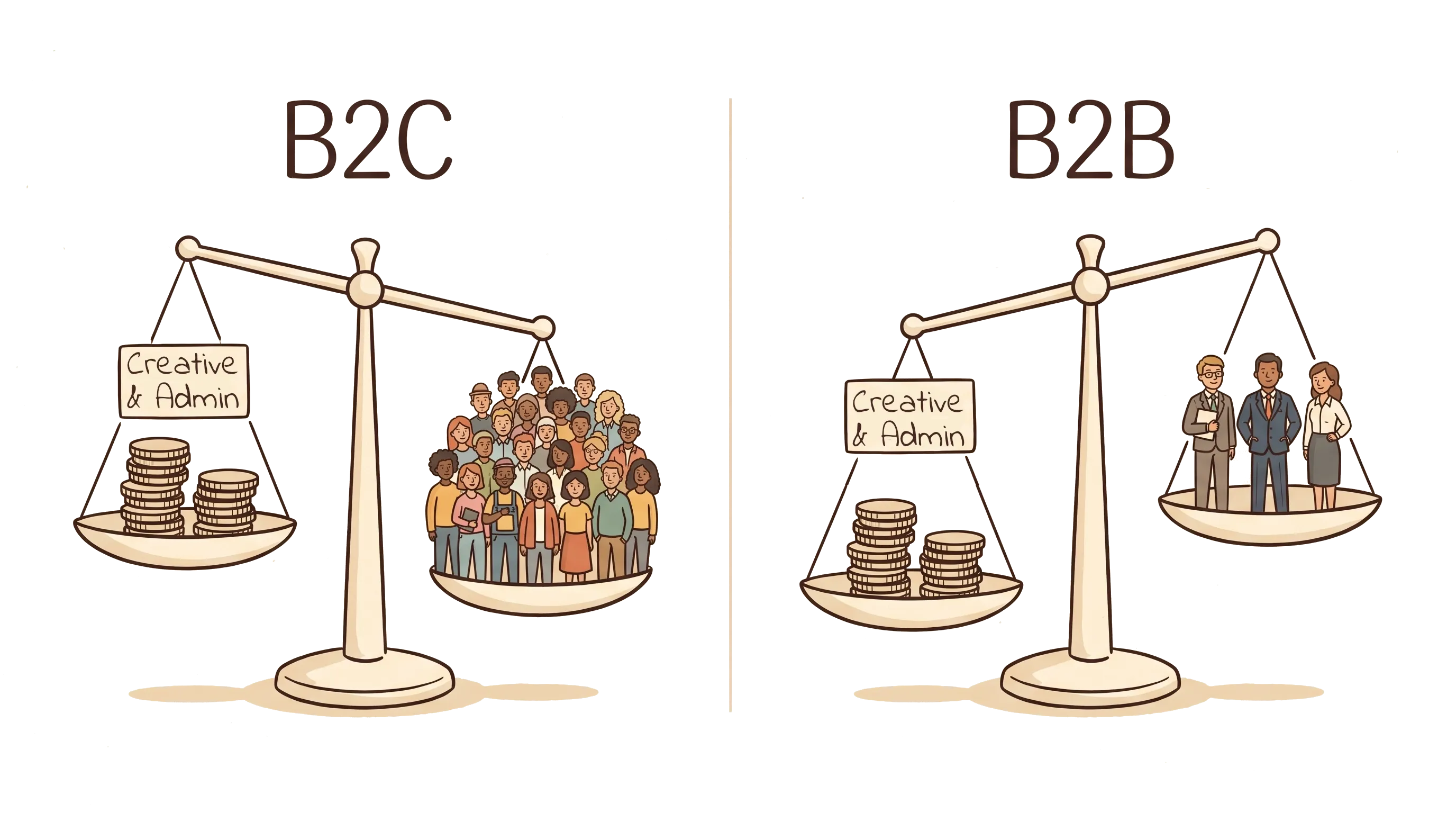
Where this comes from: It’s easy for creative budgets to mushroom on a great idea, so the industry has long pushed that to get the full ROI of your creative and management costs, you need to spend 3-4 times on ads spend than you did to make the ads and manage the campaign. This makes sense when you have a huge market and a small-dollar sale.
Why it can hurt B2B: Often in B2B, your audience is limited to a few thousand people who can actually specify or buy your product or service, but when they do, it’s tens-to-hundreds of thousands of dollars for your company. This throws the math completely out the window, and in most cases it’s literally impossible to spend 3-4 times the cost of ad creative and campaign management, without showing the ads to irrelevant people or showing them 30 times per day to the right people.
What to do instead:
- Ignore the rule and focus on getting a return on your total investment.
- Run an incremental lift study and calculate the difference between what you got in revenue with the ads vs. what you would have gotten without the ads. Then use that to calculate ROI counting both platform spend and creative and management costs.
How Path3 Helps
- We jump through all kinds of hoops on the back end to let you target small audiences with small budgets. Ad platforms aren’t made to do that and trying to do so through their interfaces is often painful or impossible.
- Path3 lets you move your investment from an agency to people you already have on staff – reducing the management costs significantly. Plus, there is always zero markup on the ad spend itself. You pay what we pay, all day, every day.
4. “Judge every campaign by this week’s ROAS.”
First, a quick definition. ROAS means Return On Ad Spend — how much money you made for every dollar you spent on ads. It’s the go-to scoreboard in B2C.
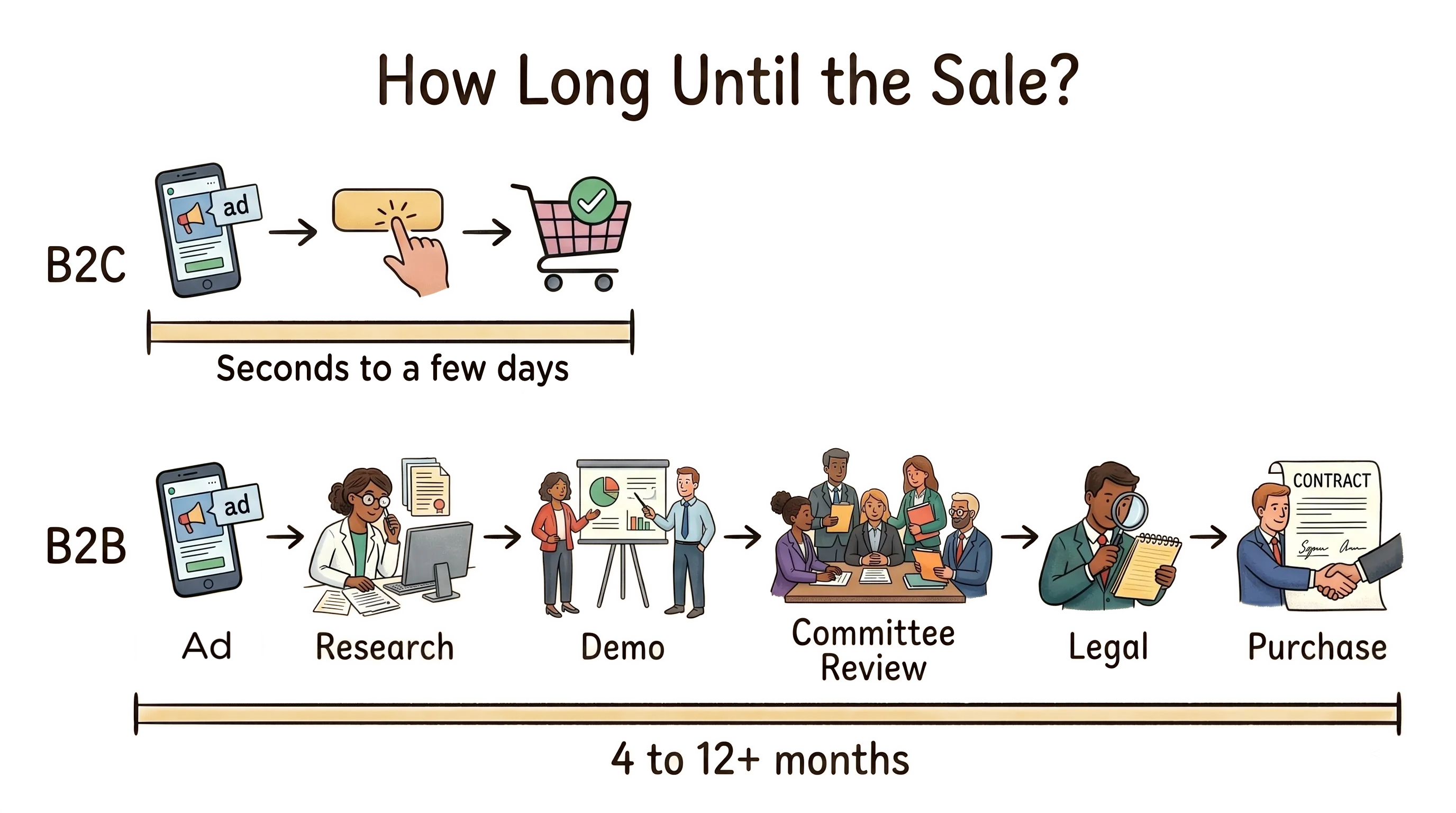
Where this comes from: A consumer can see an ad and buy minutes later. So you can look at this week’s ROAS and pretty much know if the ad, and your overal advertising budget, is working.
Why it can hurt B2B: Your sale doesn’t happen this week. Research suggests most B2B deals take several months to close — sometimes a year or more. If you judge a campaign by a 7-day ROAS window, you’re checking the scoreboard at halftime of a game that lasts all season. You’ll end up shutting off the very campaigns that are quietly building your biggest future deals.
What to do instead:
- Track engagement by the right people as a leading indicator, and pipeline (not closed sales) as a lagging indicator, to know if ads are contributing to revenue.
- Instead of attribution, again look to incremental lift as irrefutable proof that the advertising works.
- Be patient. Give campaigns time to show their real value, and look at the whole journey — not just the first click.
5. “Just feed the algorithm conversions and let smart bidding run.”
Another quick definition. Digital advertising is bought on an auction. Smart bidding is when the ad platform automatically decides how much to bid for each click, using its AI. To work well, it needs to learn — and to learn, it needs lots of examples.
Where this comes from: B2C accounts often have hundreds of sales a week. That’s plenty of data, so the AI learns what an impression and click are worth, and how many of each it takes to get a sale for a given audience. When it works, it maximizes both sales for the advertiser and ad dollars for the platform.
Why it can hurt B2B: You don’t have hundreds of sales a week. You might have a handful of deals a month. With so few examples, the AI is basically guessing. It can chase the wrong people, waste money, and swing wildly because it never gets enough data to settle down.
What to do instead:
- Give the system more signals to learn from. Track smaller “good signs” along the way (like a demo request or a pricing-page visit), not just the final sale.
- Experiment with fixed bid-caps. Tell the platforms how much an impression is worth for you and then test different values to dial in the right bid.
How Path3 Helps
- We have our own algorithms setting bids based on what works in B2B, not what the platforms are tuned for in B2C.
- Because our interests are aligned with yours, we are only optimizing for the best result for you, not trying to find a win-win for the platform.
6. “Brand is fluff. Pour everything into performance and leads.”
Where this comes from: Performance ads are easy to measure — clicks, leads, sales, all on a dashboard. Brand-building (making people feel something about your company and remember it at the right time) is harder to measure. So a lot of folks call it a waste and skip it.
Why this is risky in B2B: This might be the most expensive mistake on the list. Research from LinkedIn’s B2B Institute with Les Binet and Peter Field found that emotional, brand-focused B2B ads are about 7x more effective at driving long-term growth than purely rational, “here are our features” ads. Here’s why: at any given moment, around 95% of business buyers aren’t ready to buy yet. When they are ready, they’re not about to jump at the first no-name ad they see and buy from them. They’re going to start with the companies they know, like and trust.
What to do instead:
- Spend on brand and performance. Binet and Field suggest a roughly 46% brand / 54% performance split for B2B — heavier on leads than B2C, but with real money still going to brand.
- Focus your brand-building efforts on the known-good audience in your database and already visiting your website.
- Remember the one-way street: strong brand-building makes your lead ads work better over time. But lead ads alone can never build a brand.
How Path3 Helps
- When you run Brand Awareness ads on Path3, the platform makes sure they are delivered, even if engagement is lower. This is not true of most ad platforms that don’t value the impresson and only value the click.
- By separating your advertising into open audiences (large pools of people who look like they could be right) and closed audiences (small pools of people you know are right), you can focus your brand building efforts on the people who are right fit and run performance against those who are more speculative.
7. “Performance matters, polish does not.”
Where this comes from: Whether it’s scrappy, rough-edit iPhone videos or AI slop, the relationship between production quality (i.e. polish) and performance has been proven to be tenuous at best. The prevailing wisdom is throw more and more low-quality ads out there to see what gets the clicks and views.
Why it can hurt B2B: Picture a team deciding whether to spend $100,000 on your software. A shaky phone selfie or an AI-genrated testimonial makes them trust you less, not more. When the purchase is risky and expensive, people look for signs that you’re credible and stable. Remember: your audience is putting their job on the line recommending your company to their organization.
What to do instead:
- Aim for professional and human. Marketing expert Mark Ritson calls it “emotion with a small e”: not tears and drama, just warmth, confidence, and a little personality.
- Balance the cost of creative with the return on investment and don’t run it if you aren’t sure it maintains or raises the perception of your brand and represents the quality of the experience your customers will actually have.
8. “Use limited-time discounts to create urgency.”
Where this comes from: “Price goes up next week!” and “Sale ends at midnight!” push consumers to act fast before they overthink it. For an impulse buy, a little pressure can seal the deal.
Why it can hurt B2B: You cannot rush a group of 6 to 10 people through a months-long decision with a ticking clock. Furthermore, a 10% discount means nothing unless it’s coming out of your audience’s paycheck. They don’t pay for your solution with their wallet, they pay for it with their reputation when they stick their neck out to say you are the vendor of choice.
What to do instead:
- Time-boxed promotions work, but only if the commitment is a meeting or quote, not a sale, and the promotion is a gift or bonus item that delights the person your targeting, not the CFO.
- Otherwise, focus on staying present with the people that matter and making the onramp to entering the pipeline smooth and easy and let the prospects walk themselves in when the time is right.
How Path3 Helps
- We automate the proces of targeting the buyer’s journey. This lets you reach those who have indicated, through engagement with your company’s website and ads, that they are in a buying window.
- With Path3, you can rotate through time-boxed promotions that actually matter to your prospects, getting those dragging their feet to meet with sales, request a quote, or start the process.
The Big Picture
Here’s the thread running through all eight tips: B2B and B2C differ in the mechanics, but share the same human psychology.
The mechanics are genuinely different:
- Who buys — a group, not one person.
- How long it takes — months, not minutes.
- How many buyers exist — thousands, not millions.
- How much is at stake — a lot, both in dollars and in someone’s job.
But underneath, the psychology is the same as it’s always been: people remember brands they feel something about, and they pick what comes to mind easily and feels safe.
So don’t throw out the B2C playbook. Borrow its energy, its creativity, and its emotional punch. Just adapt it for committees, long timelines, and small audiences, and higher price-points before you hit “publish.”
And the golden rule under all of this? Test everything against your own numbers. Every “best practice” is really a starting guess. Your accounts, your buyers, and your market get the final say.
If you want an easy button to adapt B2C ad paltforms to B2B realities, Path3 is a great place to start. Check out our pricing to see if the economics work for you, or request a demo to check it out yourself.
B2B advertising is different. You deserve a B2B advertising platform that leans into those differences instead of fighting them. Path3 is that platform.